R4 Framework
A Lived Framework for Navigating Change
How the R4 Style Model Works
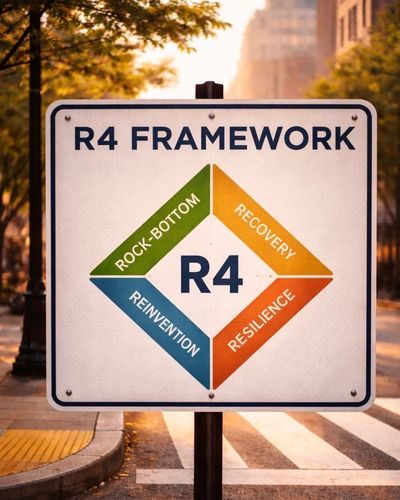
At the heart of R4 Style are four interconnected stages that reflect how people actually move through disruption—not how they are expected to.
These stages are not linear, not prescriptive, and not one-time events.
They offer a shared language for recognizing where someone is and what kind of support or care may be needed.
Rock Bottom · Recovery · Resilience · Reinvention
Rock Bottom
Where Truth Begins
Rock Bottom is the moment—or season—when life no longer resembles what was expected.
It may arrive through illness, loss, addiction, identity rupture, accumulated grief, or a quiet realization that something must change.
What defines Rock Bottom is not drama, but clarity—the recognition that life cannot continue as it has.
This stage is often marked by:
- disorientation or emotional collapse
- grief for what has been lost or can no longer be sustained
- a forced pause that cannot be bypassed
Rock Bottom is not failure. It is an honest reckoning.
Recovery
Staying Present, One Step at a Time
Recovery focuses on stabilization, care, and presence.
Rather than fixing everything, this stage emphasizes safety, support, and learning how to live inside uncertainty.
Recovery may involve:
- establishing safety and routine
- accepting medical, emotional, or community support
- learning how to remain present without rushing outcomes
Recovery is not about returning to who you were. It is about learning how to live as who you are now.
Resilience
Strength Built by Staying
Resilience emerges gradually through practice.
In this stage, strength is built through boundaries, consistency, and self-trust. Energy begins to return. Perspective widens. The future becomes imaginable again—even if it remains undefined.
Resilience often looks like:
- increased self-awareness and confidence
- clearer values and boundaries
- a growing sense of agency
Resilience is not about bouncing back. It is about learning how to stand.
Reinvention
Choosing What Comes Next
Reinvention is the act of choosing what comes next.
It does not erase the past. Instead, it integrates lived experience into a consciously shaped life.
Reinvention may involve:
- releasing inherited or outdated expectations
- making values-based decisions
- shaping work, relationships, or creative expression in alignment with lived truth
Reinvention is not starting from scratch. It is beginning again—informed by experience.
How the Stages Connect
R4 Style does not suggest a clean progression.
People may:
- move back and forth between stages
- occupy more than one stage at a time
- experience different stages in different areas of life
The value of the framework lies in recognition—not sequence.
You don’t move through R4 Style once. You return to it as life evolves.
The Metaphors in Practice
The R4 framework is supported by three guiding metaphors:
- The Curb — Rock Bottom and the forced pause
- The Crosswalk — Recovery and Resilience, where movement is deliberate and uncertain
- The Other Side of the Street — Reinvention and possibility
These metaphors are not destinations. They are ways of locating yourself—without judgment.
Closing
The R4 Framework offers a way to name where you are—without shame—and to recognize that forward movement begins with honesty.
You are not what happened to you. You are what you choose to become next.