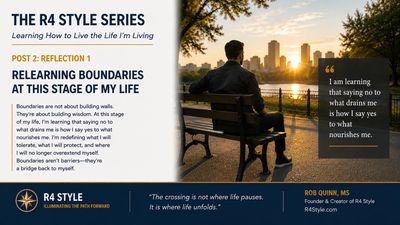
Relearning Boundaries at This Stage of My Life
May 22, 2026
There was a time in my life when I thought boundaries were mostly about other people.
I believed boundaries were something we established to keep difficult individuals at a distance, avoid conflict, or protect ourselves from being taken advantage of. While there is some truth in that, I have come to understand that healthy boundaries are about something much deeper.
They are about our relationship with ourselves.
At this stage of my life, I see boundaries less as walls and more as acts of self-respect.
They help us protect our time, our energy, our emotional well-being, and our ability to remain connected to what matters most.
That understanding took years to develop.
For much of my life, I measured my worth through responsibility. I wanted to be dependable. Helpful. Available. I wanted to contribute. I wanted people to know they could count on me.
There is nothing wrong with those qualities. In many ways, they remain important parts of who I am.
But over time, I began noticing something.
The desire to help can sometimes become a habit of overextending.
The desire to be dependable can sometimes lead to exhaustion.
The desire to avoid disappointing others can quietly result in disappointing ourselves.
Many of us learn early in life to pay close attention to the needs of others. We become skilled at recognizing what people expect from us. We respond. We adapt. We accommodate.
Eventually, however, a question emerges:
What about my needs?
Not in a selfish sense.
In an honest sense.
What do I need to remain healthy?
What do I need to feel grounded?
What do I need to continue showing up for the people and responsibilities that matter most?
Those questions have become increasingly important to me as I have grown older.
At 66, I am more aware than ever that time and energy are finite resources.
That awareness is not depressing.
It is clarifying.
It encourages me to think carefully about where my attention goes and how I spend my emotional energy.
I find myself asking different questions than I once did.
Does this commitment align with my values?
Does this relationship feel mutual?
Does this responsibility truly belong to me?
Am I acting from intention or from habit?
The answers are not always simple.
Sometimes boundaries require difficult
conversations.
Sometimes they require disappointing someone.
Sometimes they require disappointing the version of ourselves that believed we could do everything for everyone.
Yet I have learned that boundaries are not signs of selfishness.
They are signs of stewardship.
They help us care for the life we are living.
Within the R4 Style framework, boundaries often emerge during Recovery and Resilience.
After disruption changes our lives, we begin recognizing what supports our healing and what interferes with it.
We become more aware of what replenishes us and what drains us.
We learn that not every invitation requires acceptance.
Not every expectation deserves our energy.
Not every burden belongs on our shoulders.
Rock Bottom often reveals where our limits have been ignored.
Recovery teaches us to rebuild with greater awareness.
Resilience strengthens our ability to honor those limits even when it feels uncomfortable.
And Reinvention allows us to create a life that reflects what we have learned.
The crossing metaphor offers another way to understand this.
Imagine standing at the curb preparing to cross a busy street.
You cannot pay attention to every distraction around you.
You focus on where you are going.
You remain aware of your surroundings.
You move intentionally.
You protect your footing.
Life works much the same way.
Without boundaries, it becomes easy to lose focus. We become pulled in too many directions at once. We give away energy we do not have. We lose sight of our priorities.
Boundaries help us remain centered while continuing forward.
They create space for reflection.
Space for rest.
Space for meaningful relationships.
Space for joy.
Space for the parts of ourselves that often get neglected when life becomes busy.
Perhaps that is what I appreciate most about boundaries today.
They do not separate us from life.
They help us participate in life more fully.
They allow us to remain present for the people, experiences, and opportunities that genuinely matter.
The older I become, the less interested I am in proving how much I can carry.
I am more interested in carrying what is mine with intention, honesty, and care.
Maybe that is one of the quiet lessons of the crossing.
Not learning how to do more.
Learning how to honor what matters most.
Reader Reflection
Where in your life might a healthier boundary create more space for peace, balance, or authenticity?