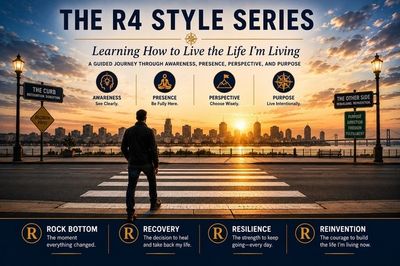
Language shapes belonging.
Over time, certain words become narrowed by association.
“Rock Bottom” becomes collapse.
“Recovery” becomes addiction-specific.
“Resilience” becomes toughness.
“Reinvention” becomes performance.
In R4 Style, these words carry a broader meaning.
They describe a human process — one that unfolds across illness, grief, disability, identity shift, burnout, addiction, or any disruption that alters the course of a life.
This four-part series reclaims each of the Four R’s.
Not to dismiss existing interpretations.
Not to compete with established models.
But to clarify how these terms function within the R4 framework.
R4 Style is built on a simple metaphor:
Rock Bottom is the curb.
Recovery is restoring footing.
Resilience is crossing.
Reinvention is life on the other side of the street.
Each stage is distinct.
Each stage matters.
Each stage is rooted in agency.
You are not pushed into the crossing.
You step.
If you have ever reached a threshold and known something must change — you have stood at the curb.
This series invites you to reconsider the language of change — and to see whether it might belong to you in ways you had not considered.
.png/:/cr=t:0%25,l:0%25,w:100%25,h:100%25/rs=w:400,h:400,cg:true)
Language shapes belonging.
Few phrases carry as much assumption as rock bottom. For many, it signals addiction, collapse, or public unraveling. That history matters. But in the R4 Style framework, Rock Bottom is broader — and more intentional — than its common use.
This post clarifies how the term functions within R4 Style.
Rock Bottom is recognition.
It is the moment you understand that continuing as you were is no longer sustainable.
That recognition may come through addiction. It may also come through illness, disability, grief, burnout, identity shift, or career loss. It can arrive suddenly or gradually — publicly or privately.
Rock Bottom is not destruction.
It is clarity.
In R4 Style, Rock Bottom marks the point where denial ends and truth becomes unavoidable. Illusion falls away. Alignment becomes necessary.
Rock Bottom, in this framework, is not:
It does not require losing everything. It does not require visible collapse. And it does not belong to one recovery model alone.
Rock Bottom is not measured by how far you fell.
It is measured by where you stopped.
In R4 Style, Rock Bottom is the curb.
The curb is where you pause long enough to see clearly. It is not punishment. It is perspective.
And here is the defining distinction:
You are not pushed into the street.
You choose whether to step off the curb.
Traditional rock bottom language centers collapse. R4 Style centers agency.
Rock Bottom becomes reclaimed when it is not something that happened to you — but a place you stood long enough to decide differently.
When the phrase is interpreted narrowly, many people quietly exclude themselves.
Clarity, however, is not limited to one experience.
If you have ever reached a point where you knew something had to change — you have stood at the curb.
Rock Bottom is not about devastation.
It is about alignment.
Where in your life have you mistaken clarity for failure?
Rock Bottom is not the end of the story.
It is where clarity replaces denial.
And once clarity settles, the next question is not whether you have fallen far enough —
but how you begin restoring your footing.

When people hear the word recovery, they often think of addiction. Twelve-step programs. Sobriety milestones. A defined path back from substance use.
That history matters. But in the R4 Style framework, Recovery is broader than one context.
This post clarifies how the term functions within R4 Style.
Recovery is restoration of footing.
If Rock Bottom is recognition — the moment you know something must change — Recovery is the steadying that follows.
It may look like stabilizing after illness. Learning to live with disability. Rebuilding after grief. Regaining direction after burnout. Reorienting identity after loss. Sustaining sobriety after addiction.
Recovery is not dramatic.
It is deliberate.
In R4 Style, Recovery is the stage where internal alignment begins to return. It is the rebuilding of trust with yourself before forward movement becomes sustainable.
Recovery, in this framework, is not:
It does not require one ideology. It does not belong to one community alone. And it is not about urgency.
Recovery is not bouncing back.
It is steadying forward.
In R4 Style, Recovery is the space between the curb and the crossing.
You do not leap into resilience.
You restore balance first.
You stabilize.
You strengthen.
You regain footing.
Without Recovery, movement becomes fragile.
Sequence matters.
When Recovery is interpreted narrowly, many people quietly assume it does not apply to them.
But rebuilding after disruption is not exclusive.
If you have reconstructed daily life after illness — that is Recovery.
If you have regained stability after grief — that is Recovery.
If you have rebuilt identity after burnout or loss — that is Recovery.
Recovery is not a label.
It is a stage.
Where in your life are you rebuilding quietly?
Recovery is not a category reserved for a few.
It is the steadying that makes movement possible.
And once your footing begins to return, the work shifts —
from stabilizing to stepping forward.
Next: Resilience, Reclaimed.

Resilience is often praised as strength, grit, or endurance — the ability to withstand hardship without breaking.
That interpretation is common. But in R4 Style, Resilience means something more grounded.
This post clarifies how the term functions within R4 Style.
Resilience is movement.
If Rock Bottom is the curb and Recovery is restoring footing, Resilience is the crossing.
It develops as you move through uncertainty. It is built through adaptation, not toughness.
Resilience may look like continuing through grief without denial. Adjusting to disability without resistance. Rebuilding after loss without erasing the past. Sustaining sobriety through daily choice. Reengaging life after burnout.
Resilience is not dramatic.
It is cumulative.
In R4 Style, Resilience forms in motion. You do not wait to feel resilient. You become resilient by crossing.
Resilience, in this framework, is not:
It is not hardness.
Toughness resists change.
Resilience adapts.
Without Recovery, what appears to be resilience is often exhaustion.
Sequence matters.
In R4 Style, Resilience is the act of crossing the street.
You are no longer standing at the curb.
You are moving forward — step by step.
Crossing requires adjustment, balance, awareness, and patience.
Resilience forms because you move — not before you do.
Resilience is often associated with dramatic hardship. But it belongs to everyday adaptation as well.
If you have learned to live within new limits — that is Resilience.
If you have rebuilt routines after disruption — that is Resilience.
If you have stayed engaged with your life despite uncertainty — that is Resilience.
Resilience is not a badge.
It is a process.
Where in your life are you already crossing?
Resilience is not hardness.
It is motion sustained.
And when you have moved through uncertainty — imperfectly but intentionally —
you arrive at the question of who you are becoming.
Next: Reinvention, Reclaimed.

Reinvention is often framed as dramatic transformation — a bold pivot, a visible overhaul, a new identity.
That narrative is common. But in R4 Style, Reinvention is quieter and more grounded.
This post clarifies how the term functions within R4 Style.
Reinvention is integration.
If Rock Bottom is the curb, Recovery restores footing, and Resilience is the crossing, Reinvention is life on the other side of the street.
You arrive informed.
Reinvention may look like redefining identity after illness. Living fully within disability.
Reorienting purpose after grief. Choosing sobriety as alignment rather than obligation.
Designing work and life differently after burnout.
Reinvention is not erasing your past.
It is authoring your next chapter with it.
In R4 Style, Reinvention reflects internal alignment made visible.
Reinvention, in this framework, is not:
It does not require spectacle.
It does not demand perfection.
And it does not skip earlier stages.
Without clarity, steadying, and movement, reinvention becomes fragile.
Sequence matters.
In R4 Style, Reinvention is standing on the other curb.
You have crossed.
You are no longer reacting to disruption.
You are designing from it.
Reinvention is not about proving you survived.
It is about living differently because you chose to move.
Reinvention is often reserved for dramatic life changes. But it also belongs to quieter redesign.
If you have adjusted your life to reflect who you are now — that is Reinvention.
If you have reshaped daily habits after disruption — that is Reinvention.
If you have carried your past forward with greater alignment — that is Reinvention.
Reinvention is not performance.
It is authorship.
Where are you already living differently because you crossed?
Reinvention is not performance.
It is authorship.
And when you look back across the street, you may realize the crossing was never about leaving who you were behind —
but carrying yourself forward differently.
The Four R’s — in order, and by choice.

In R4 Style, the order is not decorative.
It is structural.
Rock Bottom.
Recovery.
Resilience.
Reinvention.
The sequence is intentional because healing is sequential.
When the order collapses, the work collapses with it.
Modern culture encourages leapfrogging.
We are told to reinvent immediately.
To “bounce back.”
To prove resilience before we have stabilized.
But reinvention without recovery becomes performance.
Resilience without recovery becomes exhaustion.
Recovery without rock bottom becomes denial.
Sequence protects integrity.
Each stage prepares the next.
Rock Bottom is clarity.
It is the moment denial ends and truth becomes visible.
Without clarity, there is nothing to rebuild from.
You are still negotiating reality.
Rock Bottom is not collapse.
It is recognition.
You cannot skip recognition.
Recovery restores footing.
It steadies disruption.
It rebuilds alignment internally before movement accelerates externally.
Without recovery, resilience becomes brittle.
Without recovery, reinvention becomes fragile.
Recovery is not urgency.
It is stabilization.
Resilience is not declared.
It is developed.
It forms as you move forward with steadiness.
If you attempt resilience without recovery, you are enduring, not adapting.
Sequence matters because adaptation requires foundation.
Reinvention is authorship.
It is life on the other side of the street.
You cannot authentically reinvent what you have not first faced.
You cannot design forward without first stabilizing.
Reinvention is the visible outcome of invisible sequencing.
R4 Style uses the crosswalk intentionally.
You begin at the curb — Rock Bottom.
You restore footing — Recovery.
You cross — Resilience.
You arrive and design forward — Reinvention.
The crossing works because it follows order.
Step into traffic without grounding, and the crossing becomes unstable.
Sequence protects safety.
Sequence protects sustainability.
Sequence protects dignity.
Traditional rock bottom language implies collapse.
Traditional recovery language narrows to addiction.
Traditional resilience language glorifies toughness.
Traditional reinvention language celebrates spectacle.
R4 Style reframes each term — and places them in order.
Not as drama.
Not as branding.
But as structure.
Where are you in the sequence?
Are you seeking reinvention before clarity?
Are you demonstrating resilience before stabilizing?
Are you avoiding the curb entirely?
You do not need to rush the crossing.
The order exists to protect you.
And when the sequence holds, the crossing becomes sustainable.

R4 Style
Rock Bottom • Recovery • Resilience • Reinvention
R4 Style is a lived framework for navigating life after disruption—moving from
Rock Bottom through Recovery and Resilience toward Reinvention.
© Rob Quinn | R4Style.com