Language shapes belonging.
Over time, certain words become narrowed by association.
“Rock Bottom” becomes collapse.
“Recovery” becomes addiction-specific.
“Resilience” becomes toughness.
“Reinvention” becomes performance.
In R4 Style, these words carry a broader meaning.
They describe a human process — one that unfolds across illness, grief, disability, identity shift, burnout, addiction, or any disruption that alters the course of a life.
This four-part series reclaims each of the Four R’s.
Not to dismiss existing interpretations.
Not to compete with established models.
But to clarify how these terms function within the R4 framework.
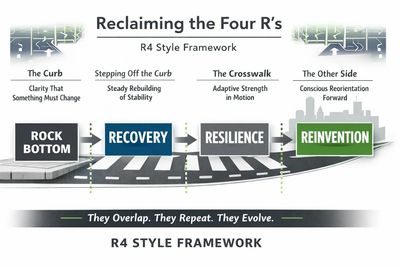
R4 Style is built on a simple metaphor:
Rock Bottom is the curb.
Recovery is restoring footing.
Resilience is crossing.
Reinvention is life on the other side of the street.
Each stage is distinct.
Each stage matters.
Each stage is rooted in agency.
You are not pushed into the crossing.
You step.
If you have ever reached a threshold and known something must change — you have stood at the curb.
This series invites you to reconsider the language of change — and to see whether it might belong to you in ways you had not considered.
Language shapes belonging.
Few phrases carry as much assumption as rock bottom. For many, it signals addiction, collapse, or public unraveling. That history matters. But in the R4 Style framework, Rock Bottom is broader — and more intentional — than its common use.
This post clarifies how the term functions within R4 Style.
Rock Bottom is recognition.
It is the moment you understand that continuing as you were is no longer sustainable.
That recognition may come through addiction. It may also come through illness, disability, grief, burnout, identity shift, or career loss. It can arrive suddenly or gradually — publicly or privately.
Rock Bottom is not destruction.
It is clarity.
In R4 Style, Rock Bottom marks the point where denial ends and truth becomes unavoidable. Illusion falls away. Alignment becomes necessary.
Rock Bottom, in this framework, is not:
It does not require losing everything. It does not require visible collapse. And it does not belong to one recovery model alone.
Rock Bottom is not measured by how far you fell.
It is measured by where you stopped.
In R4 Style, Rock Bottom is the curb.
The curb is where you pause long enough to see clearly. It is not punishment. It is perspective.
And here is the defining distinction:
You are not pushed into the street.
You choose whether to step off the curb.
Traditional rock bottom language centers collapse. R4 Style centers agency.
Rock Bottom becomes reclaimed when it is not something that happened to you — but a place you stood long enough to decide differently.
When the phrase is interpreted narrowly, many people quietly exclude themselves.
Clarity, however, is not limited to one experience.
If you have ever reached a point where you knew something had to change — you have stood at the curb.
Rock Bottom is not about devastation.
It is about alignment.
Where in your life have you mistaken clarity for failure?
Rock Bottom is not the end of the story.
It is where clarity replaces denial.
And once clarity settles, the next question is not whether you have fallen far enough —
but how you begin restoring your footing.
R4 Style is a lived approach to navigating disruption—without rushing, fixing, or erasing what came before.
A compassionate framework for major life transitions, guided by reflection, writing, and community.
© R4 Style. All Rights Reserved.