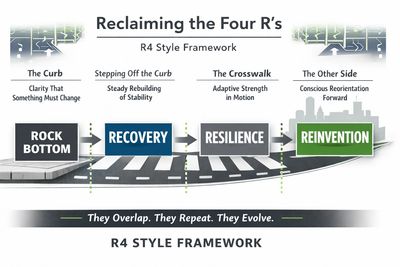
R4 Style is built on four stages: Rock Bottom, Recovery, Resilience, and Reinvention.
Over time, those words have been reduced to slogans. They’ve been treated as linear steps. They’ve been framed as motivational outcomes.
That was never the design.
In R4 Style, the Four R’s describe what happens when someone stands at the curb of change, steps into the crosswalk, and eventually reaches the other side—not once, but repeatedly.
They are not steps.
They are conditions of movement.
Many people think Rock Bottom is collapse. They imagine visible crisis or dramatic unraveling. They assume it must look extreme to count.
It doesn’t.
Rock Bottom is not collapse.
It is clarity that something must change.
In R4 Style, Rock Bottom is the moment someone stops pacing at the curb. It is the recognition that remaining where they are is no longer sustainable.
It may look stable from the outside. It may appear controlled. But internally, something has shifted. Denial has ended. Avoidance has ended. The truth has surfaced.
Rock Bottom is not falling into the street. It is deciding not to stay frozen on the sidewalk.
It begins with honesty.
And none exist without the others.
Many people think Recovery is performance. They imagine dramatic turnarounds or visible proof of change. They assume progress must be impressive to be valid.
It doesn’t.
Recovery is not performance.
It is the steady rebuilding of stability.
In R4 Style, Recovery is the first deliberate step into the crosswalk. It is movement measured carefully. It is recalibration before acceleration.
Recovery prioritizes steadiness over speed. Regulation over reinvention. It is repetitive. It is structured. It is often quiet.
This stage is not program-specific. It is broader than that. Recovery, within R4 Style, refers to stabilizing after disruption—whatever form that disruption has taken.
It requires steadiness.
And none exist without the others.
Many people think Resilience is toughness. They imagine pushing through without feeling or adapting without pause. They assume resilience means not being affected.
It doesn’t.
Resilience is not toughness.
It is the capacity to remain open while adapting.
In R4 Style, Resilience develops in the middle of the crossing. It grows while uncertainty still exists. It strengthens while the outcome is not yet guaranteed.
Resilience bends rather than breaks. It adjusts to traffic. It recalibrates with each step forward.
This stage reflects integration in motion. Stability begins to hold under pressure. Identity becomes less reactive and more deliberate.
Resilience is adaptive strength.
It asks for flexibility.
And none exist without the others.
Many people think Reinvention means becoming someone else. They imagine total overhaul or abandoning what came before. They assume reinvention requires erasing the past.
It doesn’t.
Reinvention is not reinvention of self.
It is a conscious reorientation toward what comes next.
In R4 Style, Reinvention is stepping onto the other side of the street with awareness of how you crossed. It integrates what happened at the curb and what was learned in the middle.
Reinvention does not deny Rock Bottom. It does not bypass Recovery. It does not replace Resilience. It builds from them.
It is not starting over. It is choosing direction from a steadier place.
It demands intention.
And none exist without the others.
R4 Style was never meant to describe a single walk across the street.
Rock Bottom may return in new forms. Recovery may be required again. Resilience may deepen. Reinvention may shift.
The curb reappears. The crosswalk reopens. The other side changes.
They overlap.
They repeat.
They evolve.
Reclaiming the Four R’s restores the integrity of the framework.
R4 Style is not about inspiration.
It is about clarity in motion.
And none exist without the others.

R4 Style is a lived approach to navigating disruption—without rushing, fixing, or erasing what came before.
A compassionate framework for major life transitions, guided by reflection, writing, and community.
© R4 Style. All Rights Reserved.