There was a time when I thought the goal of life was to arrive.
I imagined there would come a point when the hard work was finished, the questions were answered, and I could finally settle into a version of myself that no longer needed to change. Like many people, I believed growth belonged primarily to youth—that becoming was something we did early in life before eventually reaching a destination called adulthood.
Life had other plans.
The older I've become, the more I've realized that becoming never ends.
If anything, it becomes more intentional.
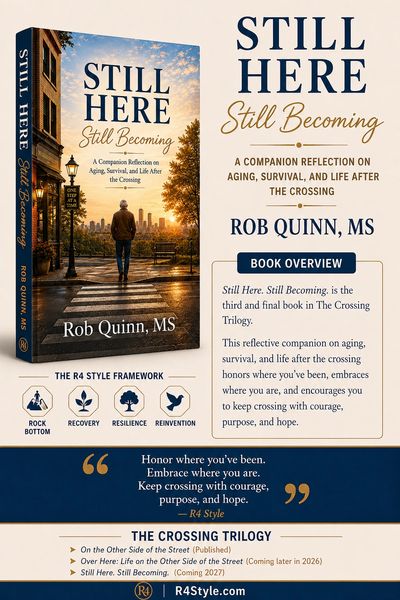
Still Here. Still Becoming. is the third book in The Crossing Trilogy, but it isn't the end of the story. It's a reflection on what it means to continue growing after we've survived life's greatest disruptions, crossed difficult streets, and built a meaningful life on the other side. It asks a question that feels increasingly important to me:
Who are we still capable of becoming?
That question has shaped this season of my life.
Living with HIV for more than three decades, recovering from addiction, navigating disability, retiring from a career that once defined my identity, losing people I love, and growing older have all taught me that life doesn't stop inviting us to grow simply because we've reached a certain age. Every season brings new opportunities to learn, contribute, adapt, and discover parts of ourselves that were waiting patiently to emerge.
The title itself carries two simple truths.
Still Here.
Those words are an acknowledgment of survival, but they're also an expression of gratitude. They recognize the privilege of waking up to another ordinary day, especially after years when I wasn't certain how many ordinary days I would have. Living through the HIV epidemic taught me never to take that gift for granted. Every sunrise, every conversation, every walk, every friendship, and every opportunity to contribute feels significant because I know they were never guaranteed.
Still Becoming.
Those words remind me that survival alone isn't the destination.
As long as we're alive, we're still learning. We're still changing. We're still discovering new ways to love, serve, create, forgive, and grow. We aren't finished simply because we've reached retirement, celebrated another birthday, or accomplished goals that once seemed impossible. Life continues asking something of us, and we continue having the opportunity to respond.
One of the greatest gifts of aging has been a shift in perspective.
When I was younger, I often measured success by achievement. I focused on career, productivity, and the expectations I believed I needed to meet. Today, I'm more interested in meaning than achievement. I care less about proving my worth and more about expressing it. That change hasn't made me less ambitious. It has made me more intentional about where I invest my time, my energy, and my attention.
I've also become more comfortable with uncertainty.
That may sound surprising after everything I've experienced, but uncertainty no longer feels like an interruption. It feels like part of being alive. I don't need to know exactly what the next chapter will look like in order to trust that it can still hold purpose. Experience has taught me that some of life's greatest gifts arrive in ways I never could have predicted.
Writing became one of those gifts.
So did speaking.
So did creating R4 Style.
None of them appeared on the list of goals I imagined for myself decades ago. They emerged because I remained open to possibilities I couldn't yet see. Looking back, I'm grateful I didn't cling too tightly to the life I thought I wanted, because doing so might have prevented me from discovering the life I was actually meant to live.
This book is also an invitation to rethink aging itself.
Too often, our culture speaks about growing older as though it were a gradual process of becoming less—less productive, less relevant, less capable, less visible. My experience has been almost the opposite. While aging certainly brings losses and limitations, it also offers perspective, wisdom, freedom, and the confidence to live more authentically. It encourages us to stop asking who the world expects us to be and begin asking who we truly want to become.
That shift feels like a form of liberation.
It reminds us that our value isn't determined by our job title, our physical abilities, our age, or the expectations of others. Our value comes from our humanity, our relationships, our willingness to keep learning, and our capacity to contribute in ways both large and small.
If On the Other Side of the Street is about beginning the crossing, and Over Here is about building a life after survival, then Still Here. Still Becoming. is about continuing the journey with intention. It's about embracing each new season with curiosity instead of fear, gratitude instead of regret, and hope instead of resignation.
Most of all, it's about recognizing that our story is still unfolding.
As long as we're here, another chapter remains unwritten.
Another lesson waits to be learned.
Another act of kindness remains possible.
Another dream is waiting to be imagined.
That's why the title is a declaration rather than a conclusion.
I'm still here.
I'm still becoming.
And I believe you are, too.
We Talk. We Share. We Learn.
The conversation continues through ongoing reflections.
The books tell my story. The blog continues the conversation—one reflection, one question, and one crossing at a time.
Continue to: Notes from the Crosswalk →
Publication Planned for 2027.

Rock Bottom • Recovery • Resilience • Reinvention
A lived-experience framework for navigating life's crossings.
We Talk. We Share. We Learn.
The crossing continues.
© 2026 R4Style.com.
All rights reserved.